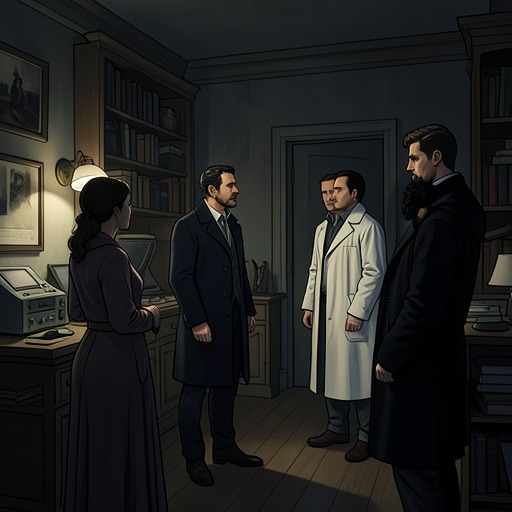
Mandhakini Devi
Ponniyin SelvanMandhakini Devi is a mute woman whose survival and long concealment bind a youthful past with the present crisis around Sundara Chozhar. Presumed dead after disappearing into the sea at Kodikkarai, she was in fact rescued and taken to Ilankai; Aniruddhar’s concealed account of that rescue later exposes how a lie meant to protect the emperor shaped their lives. When Mandhakini appears again, she is at once a living woman whom others recognize and a figure Sundara has struggled to distinguish from a haunting memory.
Identity and Background
Known as Oomai Rani and described as Poonguzhali’s aunt, Mandhakini is unable to speak and communicates through gestures. Her silence shapes the way others encounter her: they must interpret her movements, while the account of her past is carried largely by people who have watched, pursued, or hidden the truth about her. The evidence does not give her own verbal explanation of her choices. Instead, her presence, departures, and recognitions become the means by which the narrative reveals what has happened to her.
Her family connection to Poonguzhali becomes visible in two different encounters. At a stream, Mandhakini stands partly concealed among trees. Poonguzhali is startled to find her there and expects that her aunt, who dislikes outsiders, may flee when Sendhan Amudhan arrives. Mandhakini does so, bounding away into the forest; Poonguzhali leaves the boat and climbs the bank in an attempt to follow. The encounter establishes a pattern of sudden appearance followed by withdrawal, without explaining where Mandhakini has come from or where she is going.
The Concealed Survival
Aniruddhar’s confession supplies the history behind the report of Mandhakini’s death. Twenty-five years earlier, sent to find her at Kodikkarai, he heard witnesses say that she had plunged from the lighthouse into the sea. Thyaga Vidangar had recounted the apparent end, and Aniruddhar repeated that account to Sundara Chozhar. But the fall and the water had not killed her: a fisherman saw and rescued her, taking her by boat to a landing some distance from Kodikkarai.
Aniruddhar then recognized Mandhakini in the fisherman’s craft and paid the fisherman to take her to Ilankai and keep her there. He returned to Thanjai and told Sundara Chozhar that she was dead, believing that this deception would bring the emperor happiness. His confession acknowledges both the deliberate false report and the consequences he had not anticipated. When Sundara later asks whether the reports were lies, Aniruddhar confirms that Mandhakini was alive and apologizes for concealing the truth.
The secret also reaches beyond the false death report. Aniruddhar says that, after returning from years of religious study, he learned that Mandhakini had stayed for several days in the royal garden of Sembian Maadevi, where she gave birth to twins and left them there. He was also told that she sometimes returned unseen to look at the children. He asked what became of them, but was told that their fate was a secret known only to Sembian Maadevi. This account gives Mandhakini a history as a mother while leaving the children’s fate undisclosed in the evidence here.
Recognition and Return
Mandhakini’s return to Sundara Chozhar’s presence unfolds through recognition rather than speech. In a chamber lit by a single lamp, she first identifies Poonguzhali among the people gathered around the man on the bed. The others seem somewhat familiar, since she has occasionally glimpsed them from concealed places, but she does not know precisely who they are. Only after turning toward the man with marked reluctance does she recognize him.
He is the shipwrecked man she had loved when she was young, during the brief period when Boodha Theevu seemed transformed for her. The memory sets her earlier intimacy beside the altered figure before her. In the years since their time together, she had watched him without his knowledge: along the banks of the Kaveri as he travelled in royal boats, and in crowded streets as he rode in a golden chariot. She had not seen him for a considerable time. Now his beard and moustache, gaunt cheeks, lined forehead, and changed eyes make the distance between remembered youth and present age unmistakable.
Sundara Chozhar does not immediately understand that the woman before him is Mandhakini. He admits that he threw the lamp because he could not bear the sight of her gaze. Kundhavai corrects his belief that she is a ghost or spirit, identifying her as a living woman and telling him that she was never dead. When Sundara fears that she may harm Kundhavai, the Malayaman princess reassures him and settles him back onto his bed. The scene makes Mandhakini’s physical presence undeniable while showing how fear and long-held memory have made her return difficult for the emperor to accept.
Relationships and Narrative Significance
Mandhakini’s bond with Sundara Chozhar is disclosed in fragments: the earlier shipwreck, their shared time on Boodha Theevu, her continued observation of him, and the force of recognition when she sees him again. The account establishes her love as part of her past, but does not supply a spoken explanation from her or define what she expects from the reunion. The gap between what she remembers and what Sundara believes he sees—an apparition rather than a living woman—gives their encounter its emotional and narrative tension.
Her relationship with Poonguzhali offers another kind of recognition. Mandhakini identifies her niece among the people in the chamber, and Poonguzhali’s earlier pursuit shows that the family connection persists even when Mandhakini retreats from company. Their silent argument underscores how Mandhakini’s muteness makes gestures carry the exchange, while the surrounding characters must infer what she means.
The revelation of Mandhakini’s survival also changes the meaning of Sundara Chozhar’s past distress. What he experienced as possible haunting is connected to a real woman whom Aniruddhar had secretly removed from his knowledge by reporting her death. Aniruddhar’s admission exposes the human cost of that protective deception: Mandhakini’s life was hidden, Sundara’s understanding of her fate was false, and the history joining them remained unresolved. Mandhakini thus stands at the intersection of intimate memory and political secrecy—not because she explains the concealed history herself, but because her return makes its concealment impossible to maintain.